Tuesday, 21 May 2013

I can't believe you'd kill me for a field of empty holes.

So, a trivia question first - from which film is the above a quote. And possibly more importantly why on earth did it stick in my mind from an otherwise rather unmemorable movie?

Anyway, we don't have a field of empty holes (can a hole be empty?) but a field of intact soil columns. Far more valuable than holes.

Today we set up our in situ gas monitoring kit and measured green house gas fluxes from (and into) our soils prior to adding grass and then earthworms. We need this initial measurements to see how varied the gas emissions are across our soil columns and to have a base line with which to compare emissions once our plants and earthworms are doing their stuff.


Hongling and Sylvia setting up the N2O (lower big box) and CH4 (upper, smaller box) samplers.
Connecting the tubes - the yellow box just in shot is an IRGA and measures CO2 flux. It contains a pump and, thanks to the tubing that Sylvia and Hongling are connecting draws the gases coming out of the soil through itself (to measure CO2) and the N2O and CH4 monitors.
So now measurements are in progress - you can see the measuring chamber of the IRGA sat in a column just in front of Sylvia's right foot.

 
  Here is a close up of the IRGA. Below the metal cap you can see the black bellows and below that a white chamber. When it is time to measure the gas emissions the white chamber moves down onto a grey collar (you can see one in the next column at the front of the picture) and the gas starts to accumulate in the chamber. The gas is pumped through the IRGA and other analysers and we measure rate of gas accumulation in the chamber, i.e. flux.
 

We also measure soil moisture content with a Theta probe (the grey cylinder) and temperature (the white cylinder) as these will impact on the rate of greenhouse gas emissions from the soil and vary over time.
 
 
Finally, here is a screen shot of our real time N2O gas flux measurements (the top line, the lower line is real time isotopic analysis of the N allowing us to determine the source of the N2O - nitrification or denitrification). Each peak corresponds to a separate measurement and the different peak heights show us that the soils in our columns are releasing N2O at different rates.
 

Wednesday, 15 May 2013

Last week I took my penguin to the zoo......

A joke I was fond of as a child goes like this. A man found a penguin in the street and took it to the police station. "I've found this penguin, what should I do with it?" the man asked. "I'd take him to the zoo Sir" was the reply from the policeman and off the man went. The next day the policeman happened to see the same man in the local park with a penguin. "Hello", he said, "I though you were taking that penguin to the zoo". "I did", replied the man " and he enjoyed it so much that today I thought I'd take him to the park.".

I liked it anyway.

Anyhow, whilst we haven't taken our soil cores to the zoo we have taken them to Leeds School of Earth and Environment. We did this because the easiest way of getting rid of any bugs and beasts in our soil prior to adding earthworms and monitoring gas emissions was to freeze the soil. We needed the equivalent of about 10 domestic freezers worth of space and Leeds had this space free - they have more freezers than an electrical store!

One of the many freezers in Leeds School of Earth and Environment, temporarily full of soil

We left the cores in the freezers for a fortnight and have now returned them to York where Hongling is busy burying them again back where they came from.

Hongling putting the defrosted, fauna-free columns back in the soil. Note the white mesh on the bottom (held in place by a ring of car inner tube) to prevent beasts getting in or out of the bottom of the column.

Next week we'll monitor gas emissions from the soil to see what the emissions are like before the experiment begins and then we'll sow some grass, let it grow and then finally add the earthworms and start to find out how earthworms influence green house gas emissions from soils.

Thursday, 11 April 2013

Burying pipes and digging them up again

Welcome to Dr Hongling Qin from the Chinese Academy of Science, Institute of Subtropical Agriculture who has joined us for a year to work on earthworms and greenhouse gas emissions. Hongling has wasted no time getting an experiment set up. We have buried 60 drainpipes to obtain intact soil cores and are now digging them out. We'll then get rid of the macrofauna in the columns, return the columns to the soil and add different earthworm species. The plan is to monitor greenhouse gas emissions from columns with and without vegetation and with and without earthworms to see how much green house gas earthworms give off from the soil. The literature is equivocal about earthworms role in greenhouse gas emissions and we hope our work will address this gap.

Sylvia Toet and James Stockdale providing much appreciated assistance hammering the pipes into the ground.
 

Hongling demonstrates the "comedy" hammer

What do you do after burying pipes? Dig them out of course! Next we have to remove any resident beasties.

Tuesday, 26 March 2013

Exciting new lab kit

We've just taken delivery of our latest piece of hi-tech lab. kit.


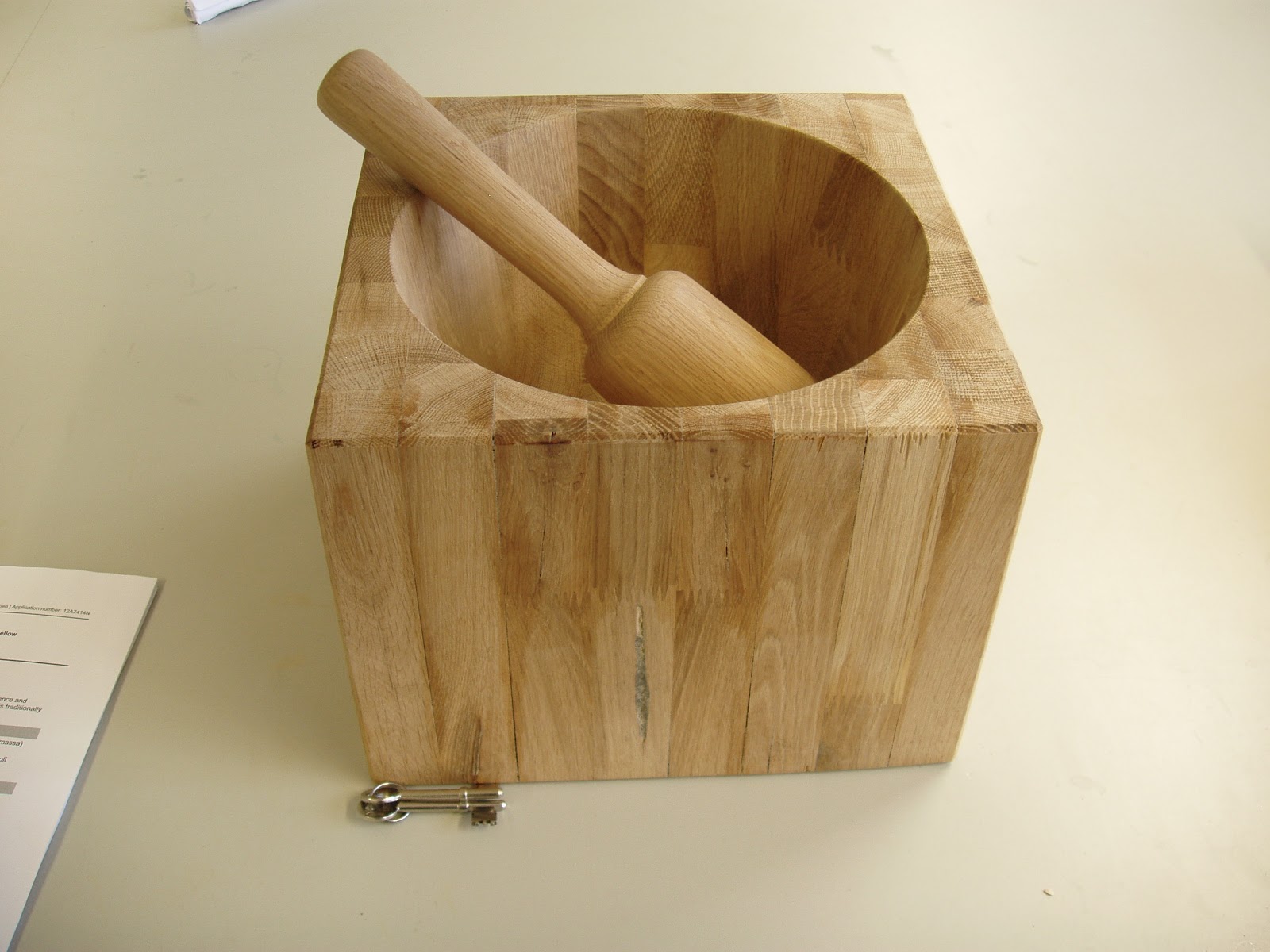
It's a lovely extra large pestle and mortar for breaking up soil, made to order from recycled oak kitchen worktops by Terry Vaughan (http://www.turnedwoodenbowls.com/). Far cheaper than buying a ceramic one from VWR or Fisher and far more satisfying to have in the lab. as well. Cheers Terry, good job.

Wednesday, 16 January 2013

Upcoming events

I'm just starting to plan two public lectures that I'm giving in the near future.

The first is at the Rutherford Appleton labs. on Fri. 25th Jan. at 1330-1430 and then again at 1900 - 2000. The second is at the Earth Science dept. in Oxford on Sat. 9th March as part of the Oxford Science festival. Details of these events, which are both free, are on my web site events page.

Monday, 24 September 2012

Diamond trip day 5: Using chocolate bars as bouyancy aids

Our time at the Diamond labs. has finished for now. What have we learnt over the last 5 sleep deprived days? Well, we have found what we were looking for in the granules. Earthworms secrete balls of calcium carbonate - CaCO3. Calcium carbonate is an interesting mineral as it can occur in a variety of different forms which differ in the way that the calcium and the carbonate are arranged relative to one another. The earthworm granules are perculiar as the different forms of calcium carbonate all occur together. Over the last five days we have tracked down a particularly rare form of calcium carbonate known as amorphous calcium carbonate. Normally this stuff converts into another form of calcium carbonate - either calcite, aragonite or vaterite - but in the earthworm balls the amorphous stuff is incredibly stable. Now that we've found the amorphous calcium carboante we can start trying to work out why it is present and why it hasn't changed into a more stable form. This may (ultimately) have industrial applications in terms of controllng calcium carbonate crystallisation which could feed into all sorts of things such as the use of calcium carbonate in pigments and preventing the precipitation of calcium carbonate in pipes causing pipe blockages.
Paul and Fred changing the sample on Beamline I18

Perhaps more importantly we have learnt the difference between baking and roasting and also that Aeros float and Mars bars sink. Whilst Crunchies float initially, over time the honeycomb dissolves and the chocolate casing then sinks. Important information if ever you find youself  thrown overboard with a choice of chocolate bars to use as bouyancy aids!

Sunday, 23 September 2012

Diamond trip: Day 4

Back to the beamline by 9.30 after finishing last "night" at about 2 a.m. We finished the night before at about 1 a.m. and had to getup at 3.30 a.m. to change sample the previous morning (or night). I'm definitely starting to get synchrotron head. The Ca XANES map we set up last night (actually 2 a.m. this morning) had almost finished by the time I got here this morning - a massive data set but probably all calcite which is rather dull when you are looking for other forms of calcium carbonate. We're now doing a few Ca XANES spots for detail and will then go on to run some diffraction standards. Then we have a final granule to XANES map and after that we'll probably try and return to some of the ACC identified in previous granules to do some EXAFS. We should get all this done before setting up a final overnight run this evening.
The long lonely corridor outside the beamline at night.

Looking across the "roofs" of the experimental hutches at Diamond.