Day 6: 28th August (posted retrospectively)
A mixed day dodging and weaving between sessions, trying to search out that killer talk. The most fun talk I heard today was about earthworm invasions. In Europe we always think of earthworms as happy little creatures keeping our soil healthy. In the northern US the last glaciation wiped out the indigenous earthworm population and European earthworms, that came to the US in the soil used as ballast, associated with European plants and, increasingly as fishing bait, are slowly spreading into the earthworm-free Sugar maple forests. They are having a significant effect on the ecology of the forests reducing the thickness of the layer of leaf litter on the soil surface and changing soil properties. It's a great natural experiment to see the effect of earthworms and Kyungsoo Yoo from the University of Minnesota gave an excellent talk on this.
I also spent some time looking at the outside of the Duomo cathedral. I'm always amazed at the amount of time and energy people put into building these things in the past. The plan is to return on Friday to have a look inside and also, early in the morning, pop up the tower for a view over Florence.
In the afternoon Emma Versteegh and I had a poster detailing our novel palaeothermometer showing how we can use the oxygen isotopes in earthworm-secreted calcium carbonate to interpret past climates. We got quite a lot of interest and chatted about how we can take the study forwards.
This evening there was a concert courtesy of the conference - string quartet, spinet and an alto for some songs. The concert was OK but the soprano used far to much vibrato for the early music (Vivaldi, Pergolesi etc.) that she was singing and the musicians came across as journeymen professionals rather than being excited by the music. There was much clapping (too much?) at the end so perhaps this critic was in a minority.
Thursday, 29 August 2013

Confessions of a conference attendee
Day 5: 27th August (posted retrospectively)
Truth be told I found yesterday rather dull. Today I had a better plan. I got up bright and early and queued outside the
Uffizi gallery to buy a ticket. The Uffizi gallery is listed as a “Must see” in
all the guidebooks, having a whole load of pictures collected by the Medici’s
including various Botticellis. The ticket office opens at 8.15 and I got there
at about 7.40, there were only 15 or so people ahead of me. I could have gone in straight away but I bought a ticket for 12.30 then headed off to the conference. I had my eye on two sessions - one on soils (known as "the critical zone" at geochemistry conferences to try and sex them up) and another on the formation of calcium carbonate. I heard some good talks by which I mean talks that make you think about your own data, think of new experiments or see ways in which you could do experiments differently. In my case there were some good thoughts about how soil particles stick together and also how to try and spot proteins in calcium carbonate. Then it was off to the Uffizi.
The Uffizi was excellent. There were some stunning paintings by various Italian masters. Many were originally hung in churches / formed the backs of altars. It made me wonder what the churches felt like - a bit like the Greeks (justifiably) wanting the Elgin marbles back perhaps. There was one painting that had been in a nunnery and apparently the nuns got a copy of the painting and a full upgrade of the nunnery plumbing in exchange for the original. Seems like a fair deal. The other interesting thing to note was that the original Botticellis looked far better than the posters you can buy. I guess this is vaguely reassuring!
Confessions of a conference attendee
Day 4: 26th August (posted retrospectively)
First day of the conference proper and everyone is very
keen. The talks start at 9 a.m. and are well attended. There’s a minor problem
in that the rooms where the talks are given are rather dark and stuffy (unless
the air conditioning is on threatening to drown out the speaker!). The rooms
have movable partition walls and whilst that’s understandable in terms of
giving the venue a flexible space it does mean that it is quite noisy.
Each day as well as the talks there are poster sessions and
I duly stuck up a poster I’d brought along for a small White Rose (Universities
of Sheffield, Leeds and York) project on earthworm secreted calcium carbonate.
Poster sessions are wonderful places to observe human behaviour. It is somewhat akin to being in a bazaar with
hawkers positioned at their posters keen to pull customers in and customers
often avoiding eye contact so as to be able to pass a poster without getting
stuck there for 30 minutes whilst someone talks to you about it.
Confessions of a conference attendee
Day 3: 25th August (posted retrospectively)
A good long sleep has set me up well to spend the day
exploring Florence. My guidebook lists 3 walking tours so I decided to do
“Walking tour 1” which should take me around Florence. The walk appeared to
involve following a bus route, at least initially making me think that “walking
tour” was somewhat inaccurate and that the guide book was probably aimed at the
majority of people, who, according to a recent newspaper article, never venture
more than 500 m from their car. The walk took in the old city wall, the old
city gate of Porta Romana, then up hill to Piazalle Galileo before a slow
descent back into central Florence via a lovely church San Miniato al Monte –
apparently a good example of Romanesque architecture and on a site that has had
a church since the time of Charlemagne - and Piazzale Michelangelo with its
stunning views across Florence. Then it was time for conference registration
and the general initial mingling of delegates / bumping into colleagues and
friends.
Confessions of a conference attendee
Day 2: 24th August (posted retrospectively!)
The day started nice and early with the bang of the corridor door at 6 am. The joys of airport hotels. Still it was a good alarm clock. All went well with my travel up to arrival in Rome (though annoyingly in Paris – I flew Air France via Paris – I saw there was a flight to Florence leaving at the same time as my flight to Rome, can’t think why it didn’t come up when I was looking for flights unless it was already fully booked, full to bursting with happy geochemists off conferencing). After arrival in Rome airport it was always going to be tight getting to the Florence train – I’d left myself 2 hours – and unfortunately it was too tight. The trains from the airport to my station in Rome were every 30 minutes, not every 15 minute as I’d read and what is more my train was 20 minutes late. In consequence I missed the Florence train by 5 minutes. Still it wasn’t like the 2 km sprint I once had to do in a Mexican airport to catch a connection and the matter was soon resolved by the purchase of a ticket for the next train. To prove that all clouds have a silver lining, I now had time to get something to eat in Rome.
The day started nice and early with the bang of the corridor door at 6 am. The joys of airport hotels. Still it was a good alarm clock. All went well with my travel up to arrival in Rome (though annoyingly in Paris – I flew Air France via Paris – I saw there was a flight to Florence leaving at the same time as my flight to Rome, can’t think why it didn’t come up when I was looking for flights unless it was already fully booked, full to bursting with happy geochemists off conferencing). After arrival in Rome airport it was always going to be tight getting to the Florence train – I’d left myself 2 hours – and unfortunately it was too tight. The trains from the airport to my station in Rome were every 30 minutes, not every 15 minute as I’d read and what is more my train was 20 minutes late. In consequence I missed the Florence train by 5 minutes. Still it wasn’t like the 2 km sprint I once had to do in a Mexican airport to catch a connection and the matter was soon resolved by the purchase of a ticket for the next train. To prove that all clouds have a silver lining, I now had time to get something to eat in Rome.
I’m now on the train to Florence, due to arrive 2217. The
hotel is near the station. Nonetheless it has been a long day and I’m looking
forward to a lie in tomorrow before exploring Florence and then registering at
the conference later in the day.
Friday, 23 August 2013
Confessions of a conference attendee
Day 1: 23rd August
I left York at 6 pm en route to the 2013 Goldschmidt International Geochemistry conference in Florence via London Heathrow
tomorrow morning and flight to Rome, changing in Paris and a train ride to
Florence. I should always remember that I am lucky to have a job with these opportunities to travel. The flights and train rides are an excellent opportunity to catch up on reading and reviewing papers and proposals if nothing else.
What should be an excellent blogging opportunity has been rendered slightly
less exciting as my wife has the camera in Edinburgh. Therefore I’ll add photos
retrospectively.
The lack of a camera is particularly disappointing tonight
as I am staying in the architectural splendour of the Heathrow Central Travel
Lodge “Welcome to the best Travel Lodge” said the receptionist, though at least
she had a smile on her face. I shall compare the architecture with great
interest to that on offer in Florence tomorrow!
Friday, 12 July 2013
Landfills and housing
Just back from a really great site visit to the Sandford Farm Remediation site near Woodley, Reading.
The site was a landfill tip from the 1960s to 1990s and has since been disused. At the end of its life the tip was capped with clay and top soil it was just left as scrub.
The site is now being developed for housing. There are two issues for consideration - gas emissions from biodegradation going on in the land fill and subsidence as the material in the landfill degrades and compacts. Neither is good for housing so the site has to be made safe.
The first thing that is done is the top soil is removed and stored - it is used to form a raised mound around the site, shielding near by residents from the noise and view of the site. The clay cap is also removed and stored for re-use.


The various stock piles of material are reblended to an engineering grade material and the excavated landfill refilled. It has had the biodegradable material (wood) removed so there is no longer a gas hazard and the refill is designed to an engineering specification so there is no subsidence risk.


At the end of the process the site is all ready for building houses. The majority of the old landfilled material has been reused as engineered back fill and the plastic waste that can't be used occupies far less space than before. And no green belt land has been used to produce some urgently needed new family homes. All excellent stuff.
The site was a landfill tip from the 1960s to 1990s and has since been disused. At the end of its life the tip was capped with clay and top soil it was just left as scrub.
 |
| This gives a view of what the site was like before development started |
The site is now being developed for housing. There are two issues for consideration - gas emissions from biodegradation going on in the land fill and subsidence as the material in the landfill degrades and compacts. Neither is good for housing so the site has to be made safe.
The first thing that is done is the top soil is removed and stored - it is used to form a raised mound around the site, shielding near by residents from the noise and view of the site. The clay cap is also removed and stored for re-use.
 |
Top soil removal |
 |
| Once the top soil has been removed you are left with the clay cap that is also removed |
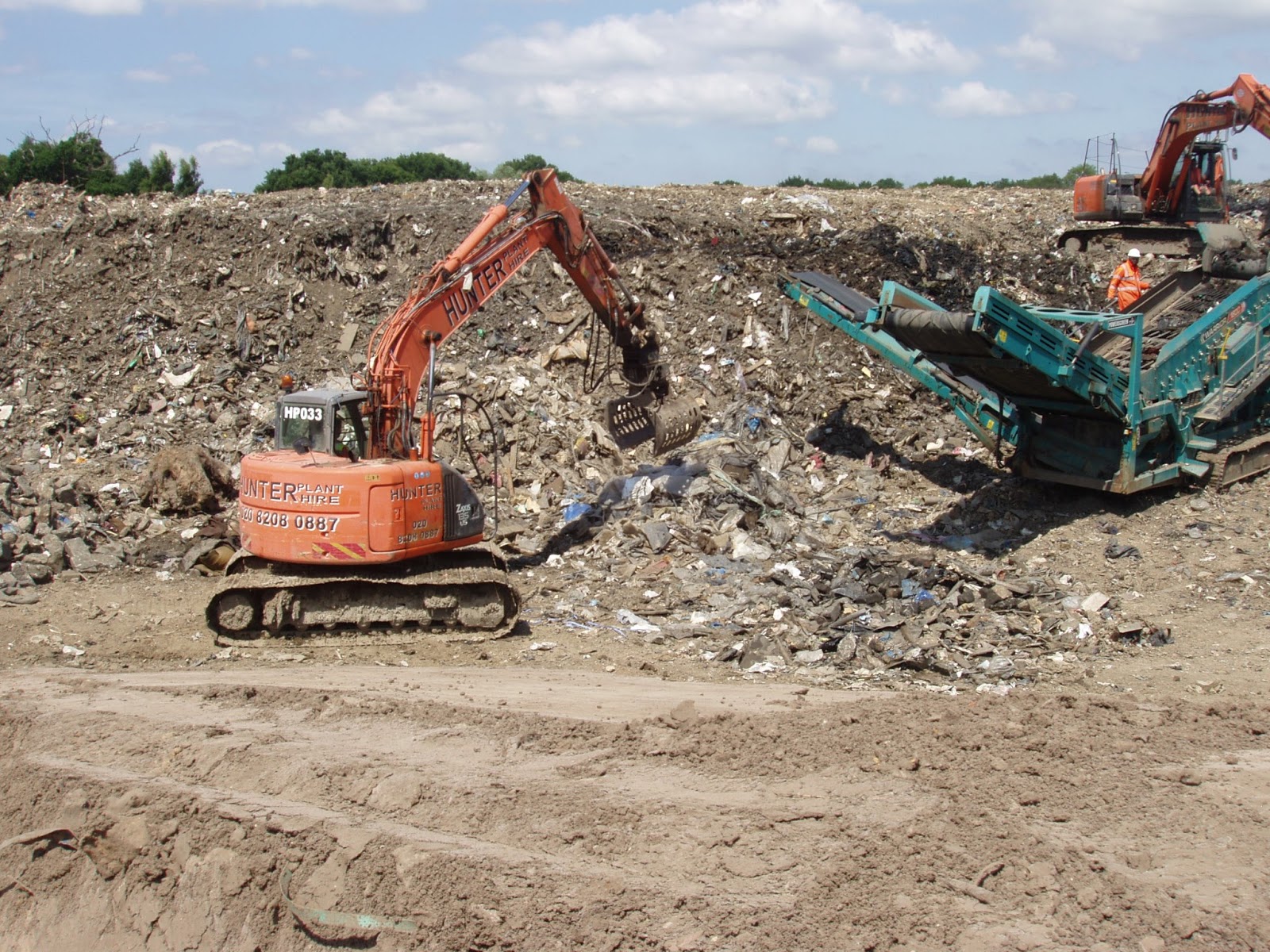
Next the rubbish has to be excavated from the landfill for removal of biodegradable material that could result in gas emissions.

Material that is relative fine grained, or is predominantly soil can be hand sorted on a conveyor belt.

The rest of the material is dumped for processing, really coarse material is separated into wood (for re-use off site), rubble (for re-use as fill on site) and plastics / tyres (for disposal off site).

Otherwise the material is sorted with machinery, initially removing coarse material.
Air blades blow off the low density plastics into a cage for collection and off site disposal.

The remaining material is put through a soil washing plant.

This works just like a gravel quarry and produces materials of different grades.

The really fine material is dewatered using a filter press.

The water is treated at an on site water treatment site and then reused.

The various stock piles of material are reblended to an engineering grade material and the excavated landfill refilled. It has had the biodegradable material (wood) removed so there is no longer a gas hazard and the refill is designed to an engineering specification so there is no subsidence risk.
Levelling off a refilled landfill site.


At the end of the process the site is all ready for building houses. The majority of the old landfilled material has been reused as engineered back fill and the plastic waste that can't be used occupies far less space than before. And no green belt land has been used to produce some urgently needed new family homes. All excellent stuff.
Subscribe to:
Posts (Atom)