Thursday, 27 June 2013

The Stephanie Powers or Katie Price of Science?

After my major triumph of not being evicted in the first round of "I'm a scientist - get me out of here!" I have now been evicted. Nonetheless, I view it as a major triumph not being evicted first. Looking at the "I'm a celebrity - get me out of here" Wikipedia entry (yes there is one!) I see this puts me in the same company as Stephanie Powers, Limahl, Sheryl Gascoigne, Nigel Benn and Katie Price (second time around) amongst others. August company.

Stephanie Powers (with Robert Wagner) in Hart to Hart, a long time ago

Meanwhile back in the real world, grass is growing in our soil columns (or at least in the ones where we want plants to be present) and Hongling has put in the earthworms. The challenge of course is knowing that the earthworms are still in there!

A column with grass


One of our grass free columns with (honestly) an earthworm burrow in the centre
 
The grey rings in the centre of the columns are where we put the smaller bit of kit for measuring gas flux - you can see photos of it in earlier blogs. By having two rings we can get gas flux from the soil with and without vegetation (from our columns with grass). The thing coming out of the middle of the soil is a rhizon sampler for sampling soil solution. Next up (next Monday) is to do our first batch of gas collection since the grass started growing and we introduced the earthworms. Hopefully we'll see some differences.
 

Tuesday, 25 June 2013

I'm a scientist - get me out of here

I’m currently taking part in “I’m a scientist – get me out of here”. Luckily there are no bush-tucker trial equivalents where you have to eat as many chemicals as possible to get points for the camp! It’s a scheme funded by, amongst others, the Science and Technology Facilities Council to help with science engagement. School pupils post in questions on the web that you have to answer. There are also live web-chat sessions. I’m competing against 4 other scientists (all PhD students as it happens) and trying to avoid being evicted by the votes of the school pupils. The first votes are in and much to my delight I haven’t been evicted! This is probably the pinnacle of my scientific career.

Hard at work answering questions from School pupils in real time

A random selection of questions for you to consider (imagine these questions coming in every 5 seconds and trying to answer them all quickly):
 
How do electrons flow through a graphine sheet? 
Hey im lewis and when im older i want to be a car sales man does this involve science?
What is the relationship of gravity to the other basic forces of the universe?
Where do bananas come from?
How do snails have babies?
Why does your tongue heal quicky?
If you put a mirror a really long way away in the universe will you see dinosaurs?
 

Tuesday, 11 June 2013

Busy bees

Things seem to be rather busy at the moment. Two weeks ago (seems like yesterday) I made my first trip to Finland. I spent a brief day and a half in Helsinki acting as the "Opponent" for the PhD defence of (now) Dr Salla Venalainen at the University of Helsinki, Faculty of Agriculture and Forestry. Salla had written an excellent thesis about how mine waste pilings from a mine in northern Finland could be used to stop phosphorus pollution in streams and remediation shooting range soil that is contaminated with lead due to all the bullets that miss the target (this is a common problem, it's not that the Finnish are particularly bad shots!). Helsinki was lovely and sunny with some great architecture, I can recommend it.

Helsinki harbour, the large white building is the cathedral

I've also been up in Glasgow acting as external examiner for the Environmental Chemistry BSc. Once again I've been very impressed by the practical skills that the students develop on the course, really good hands on experience.


This isn't a current Glasgow chemistry student but Joseph Black. He was (according to Wikipedia) an 18th century physician and chemist who discovered, amongst other things carbon dioxide. Perhaps without him global warming wouldn't exist? The chemistry department building in Glasgow (and coincidentally in Edinburgh) is named after Joseph Black.

There is also preparation for "I'm a scientist - get me out of here!" which luckily doesn't involve eating grubs but instead doing live web chats with school pupils about science. That kicks off next week - wish me luck.

Then there are grant deadlines coming up (for anyone reading this not familiar with the academic system, to do research you have to fund it and to do this you have to persuade some one to give you the money, a grant) - and a conference "Minerals for life" next week in Edinburgh all about how we are dependent on minerals for 21st century living. Should be good.

A view of Edinburgh, a lovely city surrounded by extinct volcanoes.

I guess it's all better than being bored but I'm hoping things quieten down next month.
 

Tuesday, 21 May 2013

I can't believe you'd kill me for a field of empty holes.

So, a trivia question first - from which film is the above a quote. And possibly more importantly why on earth did it stick in my mind from an otherwise rather unmemorable movie?

Anyway, we don't have a field of empty holes (can a hole be empty?) but a field of intact soil columns. Far more valuable than holes.

Today we set up our in situ gas monitoring kit and measured green house gas fluxes from (and into) our soils prior to adding grass and then earthworms. We need this initial measurements to see how varied the gas emissions are across our soil columns and to have a base line with which to compare emissions once our plants and earthworms are doing their stuff.


Hongling and Sylvia setting up the N2O (lower big box) and CH4 (upper, smaller box) samplers.
Connecting the tubes - the yellow box just in shot is an IRGA and measures CO2 flux. It contains a pump and, thanks to the tubing that Sylvia and Hongling are connecting draws the gases coming out of the soil through itself (to measure CO2) and the N2O and CH4 monitors.
So now measurements are in progress - you can see the measuring chamber of the IRGA sat in a column just in front of Sylvia's right foot.

 
  Here is a close up of the IRGA. Below the metal cap you can see the black bellows and below that a white chamber. When it is time to measure the gas emissions the white chamber moves down onto a grey collar (you can see one in the next column at the front of the picture) and the gas starts to accumulate in the chamber. The gas is pumped through the IRGA and other analysers and we measure rate of gas accumulation in the chamber, i.e. flux.
 

We also measure soil moisture content with a Theta probe (the grey cylinder) and temperature (the white cylinder) as these will impact on the rate of greenhouse gas emissions from the soil and vary over time.
 
 
Finally, here is a screen shot of our real time N2O gas flux measurements (the top line, the lower line is real time isotopic analysis of the N allowing us to determine the source of the N2O - nitrification or denitrification). Each peak corresponds to a separate measurement and the different peak heights show us that the soils in our columns are releasing N2O at different rates.
 

Wednesday, 15 May 2013

Last week I took my penguin to the zoo......

A joke I was fond of as a child goes like this. A man found a penguin in the street and took it to the police station. "I've found this penguin, what should I do with it?" the man asked. "I'd take him to the zoo Sir" was the reply from the policeman and off the man went. The next day the policeman happened to see the same man in the local park with a penguin. "Hello", he said, "I though you were taking that penguin to the zoo". "I did", replied the man " and he enjoyed it so much that today I thought I'd take him to the park.".

I liked it anyway.

Anyhow, whilst we haven't taken our soil cores to the zoo we have taken them to Leeds School of Earth and Environment. We did this because the easiest way of getting rid of any bugs and beasts in our soil prior to adding earthworms and monitoring gas emissions was to freeze the soil. We needed the equivalent of about 10 domestic freezers worth of space and Leeds had this space free - they have more freezers than an electrical store!

One of the many freezers in Leeds School of Earth and Environment, temporarily full of soil

We left the cores in the freezers for a fortnight and have now returned them to York where Hongling is busy burying them again back where they came from.

Hongling putting the defrosted, fauna-free columns back in the soil. Note the white mesh on the bottom (held in place by a ring of car inner tube) to prevent beasts getting in or out of the bottom of the column.

Next week we'll monitor gas emissions from the soil to see what the emissions are like before the experiment begins and then we'll sow some grass, let it grow and then finally add the earthworms and start to find out how earthworms influence green house gas emissions from soils.

Thursday, 11 April 2013

Burying pipes and digging them up again

Welcome to Dr Hongling Qin from the Chinese Academy of Science, Institute of Subtropical Agriculture who has joined us for a year to work on earthworms and greenhouse gas emissions. Hongling has wasted no time getting an experiment set up. We have buried 60 drainpipes to obtain intact soil cores and are now digging them out. We'll then get rid of the macrofauna in the columns, return the columns to the soil and add different earthworm species. The plan is to monitor greenhouse gas emissions from columns with and without vegetation and with and without earthworms to see how much green house gas earthworms give off from the soil. The literature is equivocal about earthworms role in greenhouse gas emissions and we hope our work will address this gap.

Sylvia Toet and James Stockdale providing much appreciated assistance hammering the pipes into the ground.
 

Hongling demonstrates the "comedy" hammer

What do you do after burying pipes? Dig them out of course! Next we have to remove any resident beasties.

Tuesday, 26 March 2013

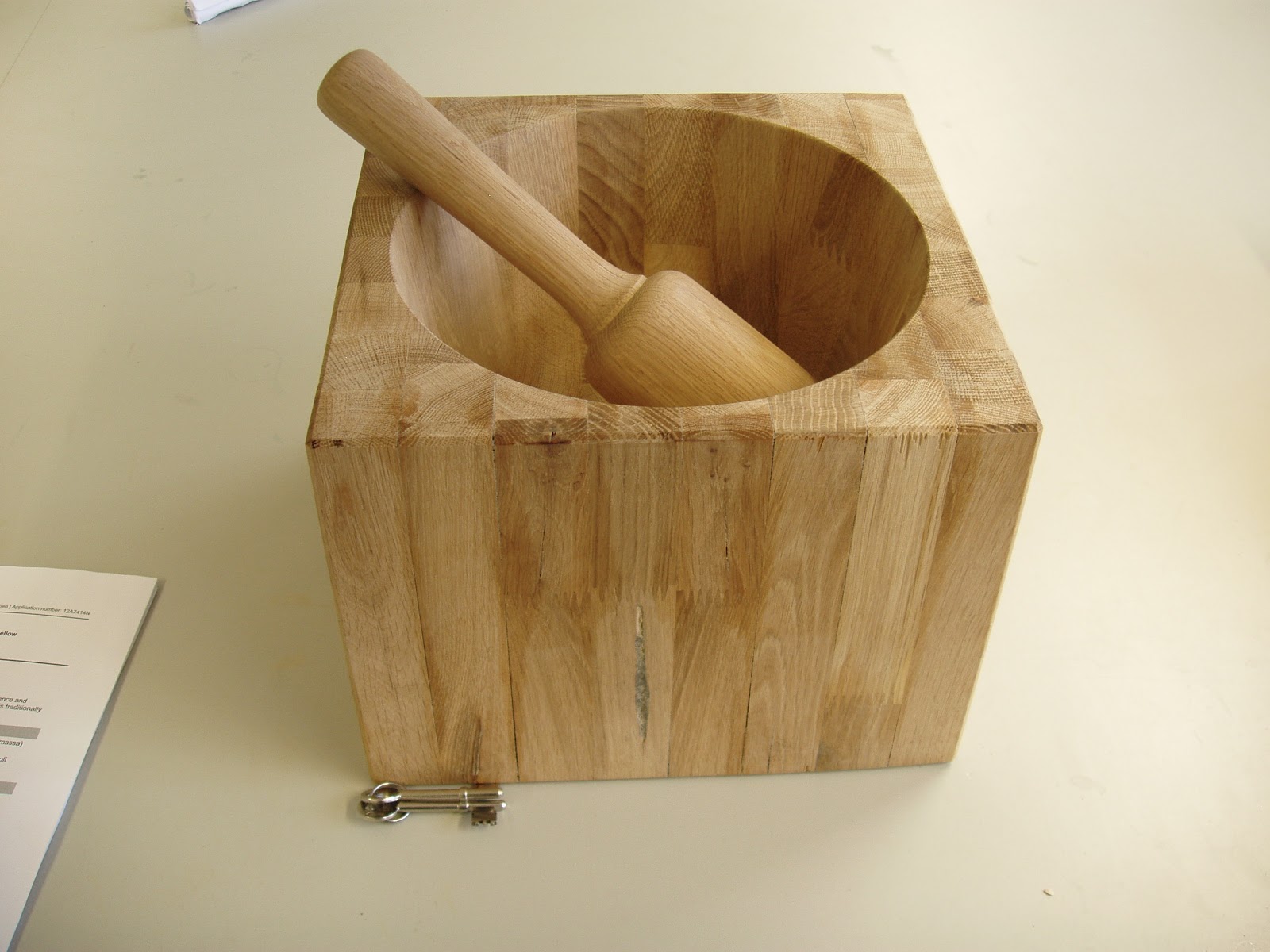
Exciting new lab kit

We've just taken delivery of our latest piece of hi-tech lab. kit.


It's a lovely extra large pestle and mortar for breaking up soil, made to order from recycled oak kitchen worktops by Terry Vaughan (http://www.turnedwoodenbowls.com/). Far cheaper than buying a ceramic one from VWR or Fisher and far more satisfying to have in the lab. as well. Cheers Terry, good job.